
What the first draft was
The earliest version of this script was written before February 2022 and had nothing to do with a war. It was about a woman who miscarries in the second trimester and begins, in the weeks afterwards, to hear her child speaking to her. It was small, domestic and almost entirely interior. Nobody in it was in danger from anything except grief.
That draft had a structural problem we could not solve. The voice of the child was either a symptom — in which case the film was a case study, and slightly cruel — or it was real, in which case the film became a supernatural story and lost its footing entirely. Every version we tried landed on one side or the other. The script sat unread for four months.
What changed was not a story note. It was the news.
The reporting from a liberated town
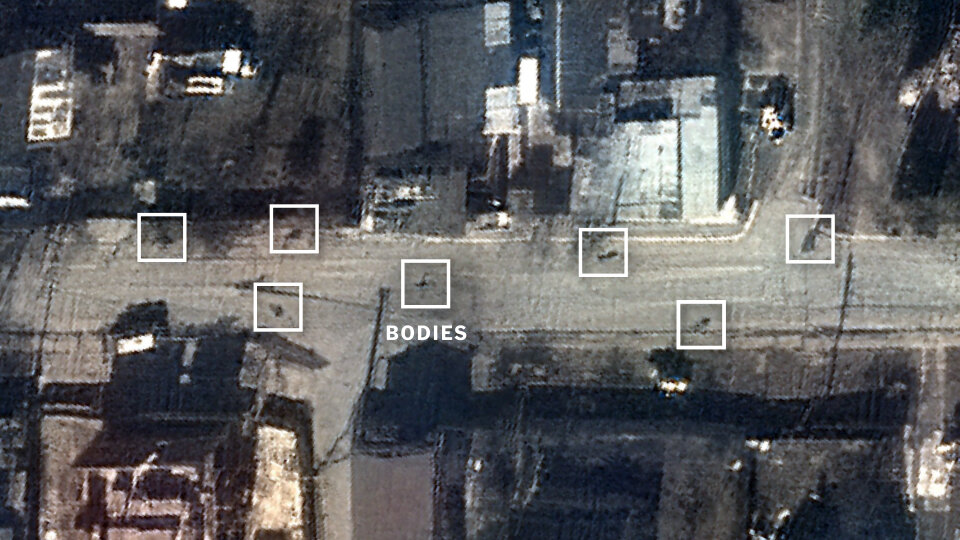
On 24 February 2022, Russia launched a full-scale invasion of Ukraine. At the beginning of April, after Russian forces withdrew from the Kyiv region, journalists and investigators entered the town of Bucha, which had been under occupation for roughly a month. What they documented there — bodies in the streets, mass graves, accounts of executions, torture and sexual violence — was reported worldwide and became the subject of formal war-crimes investigations.
Our director has written about the effect of that reporting in her statement. The sentence that mattered for the script was this one: and what we can know is only one in millions. Not the scale of the documented crimes, but the ratio between what was documented and what was not.
That ratio is the film. A woman whose experience will never be reported, investigated or counted, holding onto something nobody else can verify. The structural problem in the first draft dissolved the moment the story was placed inside a context where verification itself had collapsed.
A boundary we set immediately
We do not dramatise the testimony of identifiable real people. Everything documented in the reporting informed the world of the film; nothing from it was transcribed into a character’s mouth. Margarita is invented. What she experiences is unfortunately not.
Nine scenes that did not survive
The rewrite that followed cut nine scenes. Some of them were good. The reason each went is worth setting down, because the pattern turned out to be the film’s actual method.
Three went because they explained the voice. A scene with a doctor, a scene with a sister on the phone, a scene where Margarita reads about auditory phenomena in grief. Each of them was an argument for one interpretation over another. The film only works if that argument stays with the audience.
Four went because they showed the war. A convoy, a checkpoint, a burning building seen from a car, a soldier in a doorway. Every one of them made the film smaller — it turned an interior state into a spectacle the audience could position themselves outside of. What replaced them was sound, which is the subject of a separate article.
Two went because they were about us. Two scenes with a foreign journalist. They existed so that the audience would have a proxy in the room. Cutting them was the hardest decision in the rewrite and the most obviously correct one in retrospect.
What the research process actually looked like
We are not investigators and did not attempt to behave like them. The research had three strands, and all three were run on the assumption that we could be wrong about anything.
Published reporting and legal documentation. Reporting from established outlets, published findings from human-rights organisations, and the public record of war-crimes proceedings. This established the world: timelines, conditions, what a month of occupation does to a town’s infrastructure, what happens to a hospital.
Consultation. Conversations with displaced Ukrainian women living in Germany, arranged through community organisations, on the explicit basis that nobody was being asked to recount trauma. The questions were about texture: what a day contains, what you carry, what you stop doing, what becomes funny.
Practitioner input. A psychologist working with displaced people reviewed two drafts, specifically on the question of whether Margarita’s experience of the voice was represented in a way that a clinician would find dishonest. Her single most useful note: stop making it strange to her. It would not be strange to her.
The thing we got wrong twice
In the second and third drafts, Margarita told someone about the voice. In draft two it was her husband; in draft three, the neighbour. Both scenes were written to be moving and both were, in a workshop reading, effective.
Both were also false, and the consultation is what showed us why. The women we spoke to described, again and again, a specific kind of internal editing — a constant background calculation of what can be said out loud, to whom, and at what cost. Not secrecy exactly. Something more like triage.
Margarita does not tell anyone. That single decision reorganised the second half of the script, because it meant every subsequent scene had to carry the weight of something unspoken rather than something shared. It is harder to write and much harder to perform. It is also the only version that anyone we consulted recognised.
Why the country is never named
The script names no country, no city and no army. This is the decision people question most often, and the objection is a serious one: refusing to name Ukraine can look like a refusal to be specific about who did what to whom.
Our reasoning is narrow. The film is not a reconstruction and cannot survive being read as one. The moment a real municipality is named, every prop and every line becomes a claim about a real place on a real date — and we would be making those claims from Berlin, on the basis of secondary sources, about people who can speak for themselves and are doing so.
The director’s statement names the invasion plainly. The film does not, and we think both of those things should be true at once. If that balance turns out to be wrong, it will be wrong in public: the reasoning is here, on this page, and we would rather be argued with than assumed about.
The problem of writing about someone else’s war
Our director is from Hong Kong and lives in Berlin. She is not Ukrainian. That fact is the first thing raised in almost every meeting about this project, usually politely and always fairly, and we would rather address it here than have it circulate as an unasked question.
The argument against is straightforward and has weight: proximity confers a standing that research cannot substitute for. Ukrainian filmmakers are making work about this war now, under conditions we do not share, and there is a real risk that an outsider’s film occupies attention and funding that should go to them.
Our position has three parts. First, we are not making a film that claims documentary authority about a place — the country is unnamed, the events are invented, and nothing in it is offered as testimony. Second, the film is explicitly about what an outsider can and cannot know: the ratio between the documented and the undocumented is its structuring idea. Third, we consult, we pay for that consultation, and we treat contradiction from it as more authoritative than our own instincts.
That is a defensible position rather than an unanswerable one. If it turns out to be wrong, it will be wrong in a way that is visible in the finished film, and that is the appropriate place for it to be judged.
What a rewrite actually costs
The Bucha rewrite took five months and produced a draft roughly the same length as the one before it. From the outside this is invisible work: two documents, similar page counts, an interval.
Internally it consumed the entire development budget for that year. Two research trips, consultation fees, a psychologist’s review, three months in which the director took no paid service work, and a workshop reading with four actors. None of that appears on screen and all of it is why the screen version is not the first one.
We mention it because development budgets are the thing most consistently under-funded in small productions, and because the answer to why does this take so long is usually that a good rewrite is a research project with a script at the end of it.
The reading list
We are frequently asked what informed the world of the film. There is no bibliography in a screenplay, so here is an honest description of the categories rather than a curated list.
Contemporaneous reporting from established outlets covering the occupation and liberation of towns in the Kyiv region in spring 2022 — read chronologically, including the corrections and retractions, which are as instructive as the original pieces.
Published findings from human-rights organisations and international bodies documenting conflict-related sexual violence, which supplied the procedural and medical reality that a drama otherwise gets wrong by default.
Written testimony published by survivors themselves, in their own framing and on their own terms. This category is different from the others: it is read for understanding, never mined for material.
Work by Ukrainian filmmakers and photographers made during and about the war — as a corrective, and as a continuous reminder of what proximity produces that distance cannot.
Where the film ends up
The last scene of the script is the same one that ended the pre-2022 draft: a woman, a room, a decision, a single unbroken take. What changed is everything that leads to it and therefore everything it means.
In the first version, the decision was about grief. In this version it is about a pregnancy that resulted from an assault during an occupation, and about whether a promise made by a voice she may have invented is a sufficient reason to carry it.
We do not resolve that. The film ends before the outcome is known, holding on her face for a length of time that has already made two producers ask us to shorten it. It is the only shot in the film we will not negotiate on.
What survived from the original draft
Three things. The child’s first line, which has not changed a word since the first version. The corridor, which was a domestic corridor and is now a corridor with a taped window. And the final scene, which was always a single unbroken take of a woman making a decision, and which now carries a weight it was never designed to hold.
That last one is the reason we keep the earliest draft in the project folder. The scene is identical. The film around it changed completely, and the scene became something else without a single alteration — which is the most useful lesson this rewrite taught us about what context does.